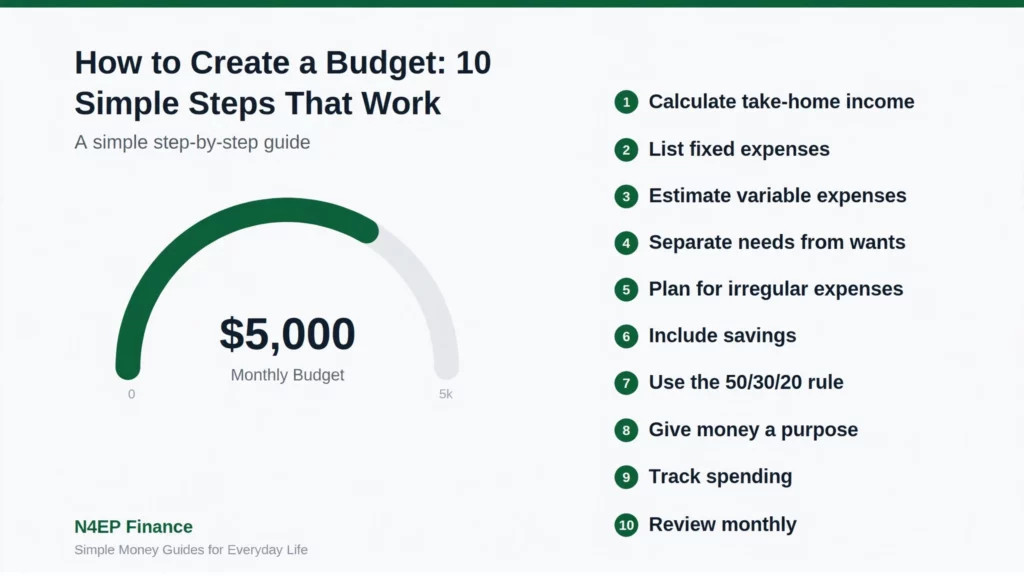
How to create a budget is one of the simplest ways to take control of your money. A good budget helps you understand how much you earn, where your money goes, how much you can save, and how much you can comfortably spend each month.
What You'll Learn
- What Is a Budget?
- Why Is Creating a Budget Important?
- How to Create a Budget Step by Step
- A Simple Monthly Budget Example
- What If Your Expenses Are Higher Than Your Income?
- How to Stick to a Budget
Creating a budget does not mean giving up everything you enjoy. Instead, it gives your money a clear purpose and helps you make better financial decisions.
Whether you’re completely new to personal finance or you’ve tried budgeting before and struggled to stick with it, this guide will show you how to create a budget that is realistic, flexible, and easier to maintain.
What Is a Budget?
A budget is a plan for how you intend to use your money during a specific period, usually a month.
At its simplest, a budget compares your income with your expenses and financial goals.
Monthly income − monthly expenses = money left over
Your expenses may include housing, groceries, transportation, insurance, debt payments, entertainment, subscriptions, savings, and other financial commitments.
A good budget doesn’t need to predict every expense perfectly. Its purpose is to give you a clear picture of your finances so you can make intentional decisions about your money.
For additional consumer guidance on budgeting and managing money, the Consumer Financial Protection Bureau’s budgeting resources provide useful information.
Why Is Creating a Budget Important?
Learning how to create a budget can help you understand your spending habits and make better financial decisions.
A realistic budget can help you:
- Know where your money is going
- Plan for important bills
- Reduce unnecessary spending
- Build savings
- Prepare for irregular expenses
- Manage debt payments
- Work toward financial goals
- Avoid consistently spending more than you earn
A budget can also make it easier to identify financial problems before they become larger issues.
For more practical money-management content, visit the N4EP Money & Budgeting section.
How to Create a Budget Step by Step
If you’re wondering how to create a budget for the first time, don’t try to make everything perfect immediately. Start with your real numbers and improve the plan as you learn more about your spending.
1. Calculate Your Monthly Take-Home Income
Start with the money you actually have available rather than your gross salary.
For many employees, this means using take-home pay—the amount that reaches your bank account after taxes and other payroll deductions.
For example, if you bring home $4,000 per month, that is the amount you should use as the starting point for your monthly spending plan.
If you have multiple income sources, include income you reasonably expect to receive.
This could include:
- Salary or wages
- Freelance income
- Self-employment income
- Side-business income
- Regular bonuses
- Other predictable income
If your income changes from month to month, use a conservative estimate based on your recent income rather than building your budget around your highest-earning month.
The goal is to create a monthly budget that you can realistically follow.
2. List Your Fixed Monthly Expenses
Next, list expenses that usually remain relatively stable.
Common fixed expenses include:
- Rent or mortgage
- Car payments
- Student loan payments
- Insurance premiums
- Internet
- Phone service
- Subscription services
- Minimum debt payments
For example:
| Fixed Expense | Monthly Cost |
|---|---|
| Rent | $1,400 |
| Car payment | $350 |
| Insurance | $180 |
| Internet | $70 |
| Phone | $60 |
| Student loan | $200 |
| Total | $2,260 |
Knowing your fixed expenses helps you understand how much of your income is already committed before you make other spending decisions.
3. Estimate Your Variable Expenses
Variable expenses can change from month to month.
Examples include:
- Groceries
- Gas
- Electricity
- Dining out
- Entertainment
- Clothing
- Household purchases
- Personal care
Instead of guessing, review your recent bank statements and credit card transactions.
For example, if you discover that you have been spending around $450 per month on groceries, creating a $150 grocery budget may not be realistic.
Your first budget should reflect your actual spending patterns.
Once you understand where your money is going, you can gradually decide which expenses you want to reduce.
4. Separate Needs From Wants
An important part of how to create a budget is understanding the difference between needs and wants.
Needs
Needs are expenses that are generally necessary for your household and financial obligations.
Examples include:
- Housing
- Basic groceries
- Utilities
- Transportation
- Insurance
- Required debt payments
Wants
Wants are purchases that can improve your lifestyle but aren’t generally essential.
Examples include:
- Restaurant meals
- Entertainment
- Streaming services
- Hobbies
- Nonessential shopping
- Premium subscriptions
The difference isn’t exactly the same for everyone.
For example, internet service may be essential if you work from home, while someone else may have more flexibility around that expense.
The goal isn’t to eliminate wants. It’s to understand your priorities so you can decide how much money you want to spend on them.
5. Plan for Irregular Expenses
Many budgets fail because they only account for monthly bills.
Some expenses happen only a few times a year but still need to be included in your financial plan.
Examples include:
- Car repairs
- Vehicle registration
- Holiday gifts
- Annual memberships
- Property taxes
- Home maintenance
- Medical expenses
- Annual insurance payments
- Vacations
- School-related expenses
Suppose you expect to spend about $1,200 during the year on vehicle maintenance and registration.
You could divide the expected amount by 12:
$1,200 ÷ 12 = $100 per month
By setting aside $100 each month, you can make a future expense easier to handle.
These separate savings categories are often called sinking funds.
Planning for irregular expenses is one of the most useful parts of learning how to create a budget because it helps prevent occasional bills from completely disrupting your monthly finances.
6. Include Savings in Your Budget
Don’t make savings whatever happens to be left after you’ve spent everything else.
Instead, include savings as one of the planned destinations for your income.
Your savings goals might include:
- Emergency savings
- Retirement
- Home down payment
- Car replacement
- Education
- Vacation
- Large future purchases
For example, if your monthly take-home income is $4,000 and you plan to save $400:
$4,000 − $400 = $3,600
That means your other planned expenses need to fit within the remaining $3,600.
There isn’t one savings percentage that works for every household. Your ideal amount depends on your income, expenses, debt, emergency savings, and financial goals.
For more money-saving guidance, explore the N4EP Saving section.
7. Consider the 50/30/20 Budget Rule
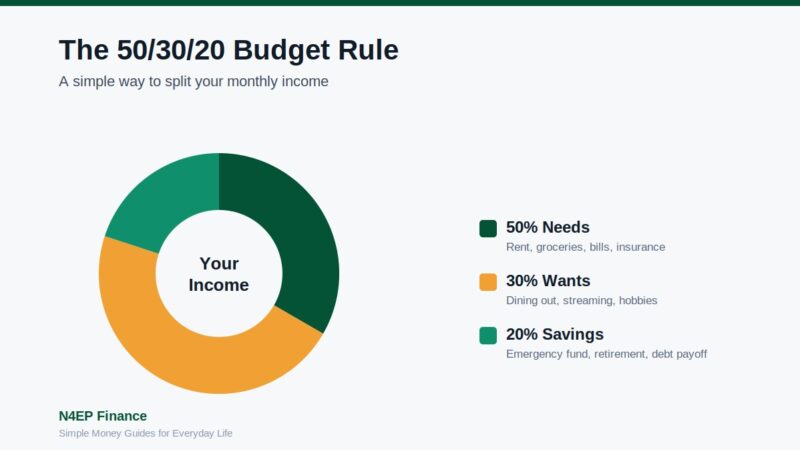
The 50/30/20 rule is a popular framework for organizing your money.
Under this approach:
- 50% goes toward needs
- 30% goes toward wants
- 20% goes toward savings and debt goals
For someone with $4,000 in monthly take-home income, that could look like:
| Category | Percentage | Example Amount |
|---|---|---|
| Needs | 50% | $2,000 |
| Wants | 30% | $1,200 |
| Savings & debt goals | 20% | $800 |
| Total | 100% | $4,000 |
These percentages are not requirements.
Housing costs, income, debt, family size, location, and financial goals can make another breakdown more appropriate.
Think of the 50/30/20 rule as a starting framework rather than a strict formula.
You can also explore more personal-finance guides in the N4EP Money & Budgeting section.
8. Give Every Dollar a Purpose
Once you know your income and expenses, create a plan for where your money should go.
For example, someone earning $5,000 per month could create a plan like this:
| Category | Monthly Amount |
|---|---|
| Housing | $1,500 |
| Utilities & phone | $300 |
| Groceries | $500 |
| Transportation | $500 |
| Insurance | $250 |
| Debt payments | $300 |
| Entertainment & dining | $300 |
| Personal & household | $250 |
| Emergency savings | $500 |
| Retirement/investing | $400 |
| Irregular expenses | $200 |
| Total | $5,000 |
This example gives every dollar a purpose.
However, your numbers may look completely different.
If your housing costs are higher, you may need to spend less in other categories. If you have less debt, you may be able to put more toward savings or investing.
A good budget should reflect your actual circumstances rather than someone else’s financial situation.
9. Track Your Actual Spending
Creating a budget is only the beginning.
You also need to compare your plan with what actually happens during the month.
You can track your spending using:
- A spreadsheet
- A budgeting app
- Your bank’s spending tools
- A notebook
- A simple budgeting worksheet
You don’t need expensive software.
A simple system that you consistently use can be more valuable than a complicated system that you abandon after a few days.
For example, if you planned to spend $400 on groceries but actually spent $475, record the difference.
Don’t change the number simply to make your budget look better.
Your actual spending provides useful information that can help you create a better plan next month.
10. Review and Adjust Your Budget Every Month
Your first budget probably won’t be perfect.
That’s normal.
At the end of each month, review your results and ask:
- Which expenses were higher than expected?
- Which categories were lower?
- Did I save the amount I planned?
- Did an unexpected expense appear?
- Are there subscriptions I no longer use?
- Did my income change?
- What should I adjust next month?
Your budget should change when your financial circumstances change.
A new job, rent increase, new debt, major purchase, or change in household expenses may require you to update your plan.
Regular review is one of the most important parts of how to create a budget that continues to work over time.
A Simple Monthly Budget Example
Here’s an example of a monthly budget for someone bringing home $5,000:
| Category | Monthly Amount |
|---|---|
| Housing | $1,500 |
| Utilities & phone | $300 |
| Groceries | $500 |
| Transportation | $500 |
| Insurance | $250 |
| Debt payments | $300 |
| Entertainment & dining | $300 |
| Personal & household | $250 |
| Emergency savings | $500 |
| Retirement/investing | $400 |
| Irregular expenses | $200 |
| Total | $5,000 |
This is only an example and isn’t a recommended budget for every household.
Your own monthly budget should reflect your income, household size, location, debts, financial obligations, and goals.
What If Your Expenses Are Higher Than Your Income?
If your budget shows that your expenses are consistently higher than your income, don’t ignore the difference.
Start by reviewing your spending and identifying realistic opportunities to reduce expenses.
Look at:
- Subscriptions
- Dining out
- Entertainment
- Shopping
- Transportation
- Insurance costs
- Phone and internet plans
- Other recurring expenses
Then look at your largest expenses.
If housing, transportation, or debt payments consume most of your income, cutting small purchases may not solve the entire problem.
You may need to consider larger changes, such as reducing major expenses, increasing income, or creating a plan to manage high-interest debt.
The first step is understanding the gap.
A negative number in your budget isn’t necessarily a failure. It is information that shows your current plan needs to change.
How to Stick to a Budget
Knowing how to create a budget is only part of the process. Following your plan consistently is where the real benefit comes from.
Make Your Budget Realistic
Don’t create a plan that assumes you’ll never eat at a restaurant, buy clothes, or spend money on entertainment.
A budget that is too restrictive may be difficult to maintain.
Give yourself reasonable spending categories while keeping your larger financial goals in mind.
Automate Your Savings
If possible, consider automatically transferring a predetermined amount into savings after payday.
Automation can make saving more consistent because you don’t have to remember to move the money manually.
Check Your Spending Regularly
You don’t need to spend hours analyzing your finances every day.
A quick review several times during the month can help you identify problems before they become larger.
Plan for Unexpected Costs
Leave some flexibility in your monthly plan for expenses you didn’t anticipate.
Your budget should guide your decisions without becoming so rigid that one unexpected bill completely destroys your plan.
Set Specific Financial Goals
Instead of saying, “I want to save more,” create a measurable target.
For example:
Save $3,000 for an emergency fund within 12 months.
A specific goal gives you something concrete to work toward.
Don’t Give Up After One Bad Month
Going over budget in one category doesn’t mean the entire plan failed.
Look at what happened, adjust your numbers, and continue.
Consistency over time matters more than having a perfect month.
Common Budgeting Mistakes to Avoid
1. Forgetting Small Expenses
Small purchases can add up over time.
Review your transactions so you understand how much you’re actually spending.
2. Ignoring Annual Expenses
Annual and occasional bills should still have a place in your financial plan.
3. Creating Too Many Categories
Your budget doesn’t need dozens of categories.
Start simple and add detail when it provides useful information.
4. Setting Unrealistic Spending Limits
If a spending limit doesn’t reflect reality, you’ll constantly feel like you’re failing.
Use your previous spending as a starting point and make gradual improvements.
5. Forgetting to Update Your Budget
Your income, expenses, and financial goals can change.
Review your budget regularly and make adjustments when necessary.
Frequently Asked Questions
What is the easiest way to create a budget?
Start with your monthly take-home income and list your fixed and variable expenses. Then include savings and irregular expenses. Compare your total planned spending with your income and adjust the numbers until the plan is realistic.
How do I create a budget for the first time?
To create a budget for the first time, calculate your take-home income, review your recent spending, list your bills, separate needs from wants, plan for irregular expenses, and set savings goals. Then track your actual spending and adjust the plan each month.
How much should I save each month?
There is no single savings amount that works for everyone. Your target depends on your income, expenses, debt, emergency fund, and financial goals. Start with an amount you can realistically maintain and increase it when your circumstances allow.
Is the 50/30/20 rule a good budget?
The 50/30/20 rule can be a useful starting framework for budgeting beginners. However, it isn’t a requirement. Your ideal percentages may be different because of housing costs, debt, income, family size, and other financial circumstances.
What should I do if I can’t afford to save?
Start with a small amount if your budget allows. If your expenses are higher than your income, focus first on understanding the shortfall and identifying realistic ways to stabilize your monthly finances.
How often should I review my budget?
A quick spending check during the month and a more detailed review at the end of each month can work well. You should also update your budget whenever your income or major expenses change.
Should I use a budgeting app?
A budgeting app can be useful, but it isn’t required. A spreadsheet, notebook, or simple budgeting worksheet can work just as well if you use it consistently.
What is the best budgeting method for beginners?
A simple monthly budget is a good starting point. You can also experiment with approaches such as the 50/30/20 rule and adjust the system based on your income, expenses, and financial goals.
Final Thoughts
Learning how to create a budget can give you a clearer picture of your finances and help you make more intentional decisions with your money.
Start by calculating your take-home income. List your fixed and variable expenses, plan for irregular costs, include savings, and track what you actually spend.
Then review your results and adjust your plan each month.
Your first budget doesn’t need to be perfect. The goal is to create a system that works with your real life and helps you move toward your financial goals.
N4EP Finance Tip: Start simple, track your spending, and make small improvements every month.
Disclaimer: This article is for educational purposes only and should not be considered personalized financial advice. Individual financial circumstances vary.