The 50/30/20 budget rule is one of the simplest and most popular ways to manage your money without spreadsheets, complicated apps, or hours of tracking every coffee you buy. This budgeting method splits your after-tax income into three easy buckets: needs, wants, and savings.
What You'll Learn
- What Is the 50/30/20 Budget Rule?
- How to Calculate Your 50/30/20 Budget
- What Counts as a “Need” vs. a “Want”?
- What If Your Numbers Don’t Fit the Rule?
- Tips to Make the 50/30/20 Budget Rule Work for You
- Is the 50/30/20 Budget Rule Right for You?
If you’ve ever felt overwhelmed trying to build a budget from scratch, the 50/30/20 budget rule gives you a clear starting point without requiring you to categorize every single expense.
What Is the 50/30/20 Budget Rule?
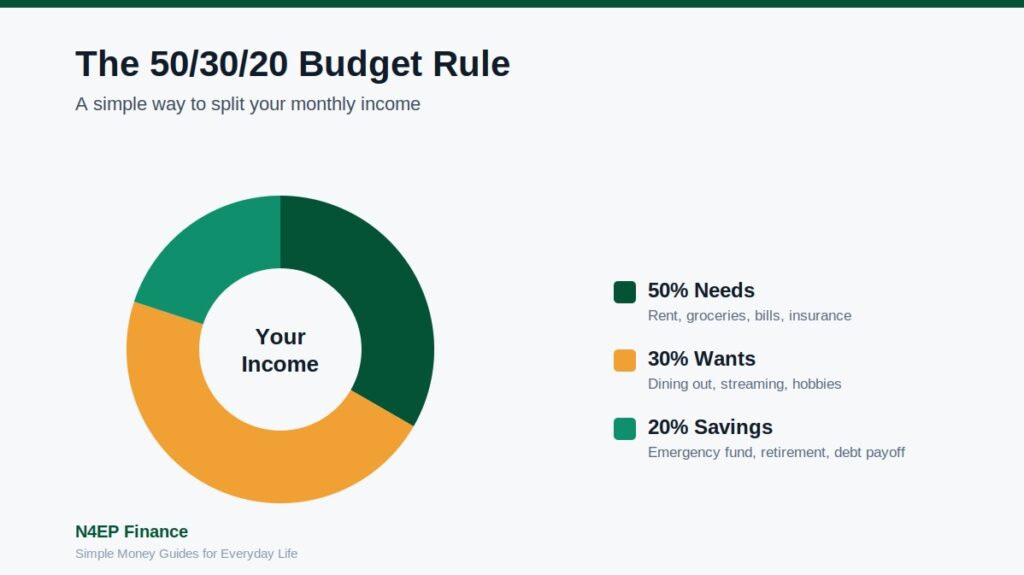
The 50/30/20 budget rule breaks your monthly take-home pay into three simple categories:
- 50% for Needs — Things you must pay for to live and work: rent or mortgage, groceries, utilities, insurance, minimum debt payments, and transportation.
- 30% for Wants — Non-essential spending that makes life enjoyable: dining out, streaming subscriptions, hobbies, travel, and shopping.
- 20% for Savings and Debt Payoff — Building your emergency fund, contributing to retirement accounts, and paying down debt faster than the minimum.
This framework was popularized by U.S. Senator Elizabeth Warren in her book All Your Worth, and the 50/30/20 budget rule remains one of the most widely recommended starting points for beginners.
How to Calculate Your 50/30/20 Budget
Start with your monthly take-home pay — the amount that actually lands in your bank account after taxes.
Example: $4,000 monthly take-home pay
| Category | Percentage | Amount |
|---|---|---|
| Needs | 50% | $2,000 |
| Wants | 30% | $1,200 |
| Savings/Debt | 20% | $800 |
From here, you simply track your spending against these three buckets instead of dozens of tiny categories. This is what makes the 50/30/20 budget rule so easy to stick with long-term.
What Counts as a “Need” vs. a “Want”?
This is where most people get stuck when applying the 50/30/20 budget rule. A general rule of thumb:
- Needs are things you’d still need even on your tightest possible budget — basic housing, basic groceries, essential utilities, insurance, and minimum debt payments.
- Wants are anything beyond the “basic” version — name-brand groceries instead of store-brand, a bigger apartment than you need, subscription services, entertainment, and eating out.
If you’re unsure whether something is a need or a want, ask yourself: “Would I still buy this if money were tight this month?” If the answer is no, it’s probably a want.
What If Your Numbers Don’t Fit the Rule?
In high cost-of-living areas, spending 50% or less on needs isn’t always realistic — rent alone can eat up more than half of many people’s income. If that’s your situation:
- Don’t panic — the 50/30/20 budget rule is a guideline, not a strict law.
- Try adjusting to something like 60/20/20 or 65/15/20 temporarily.
- Focus first on getting your savings percentage as close to 20% as possible, even if needs and wants shift.
- Revisit the ratio every few months as your income or expenses change.
Tips to Make the 50/30/20 Budget Rule Work for You
- Automate your savings — Set up an automatic transfer to a savings account on payday so the 20% happens before you’re tempted to spend it.
- Use separate accounts or envelopes — Some people find it easier to physically separate their “wants” money into its own account.
- Review monthly, not daily — This method works best when you check in once a month rather than obsessing over every transaction.
- Adjust as life changes — A raise, a new baby, or a move should all trigger a quick budget review.
For more general guidance on building a spending plan, the Consumer Financial Protection Bureau offers free, unbiased budgeting tools and worksheets.
Is the 50/30/20 Budget Rule Right for You?
This method works best for people who want simplicity over precision. If you prefer detailed, itemized budgeting (like zero-based budgeting), the 50/30/20 budget rule might feel too loose. But if you’ve struggled to stick with more complex systems in the past, this approach removes a lot of the friction — making it far more likely you’ll actually stick with it long-term.
Budgeting isn’t about perfection. It’s about building a system simple enough that you’ll actually follow it — and the 50/30/20 budget rule is one of the easiest ways to get started.
Disclaimer: This article is for general informational purposes only and does not constitute personalized financial advice. Please consult a licensed financial professional before making financial decisions.

2 Comments