

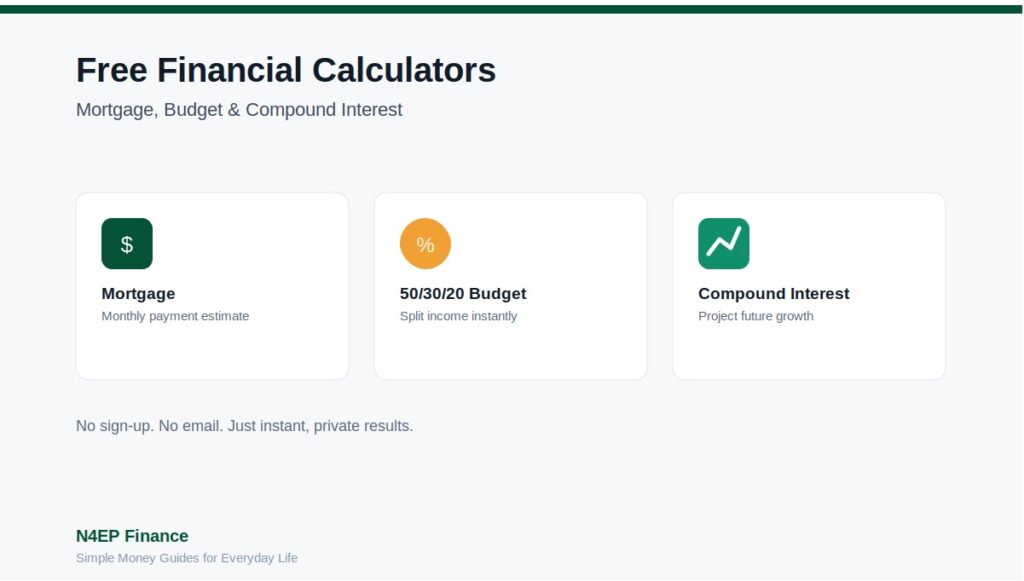
These financial calculators let you run your own numbers instantly, right in your browser — no sign-up, no email address, and no downloads required. Whether you’re planning a home purchase, building a monthly budget, or estimating how your savings could grow over time, these tools give you a fast, private starting point before you talk to a lender or financial advisor.
Each calculator below uses standard financial formulas, the same ones lenders and financial planners rely on, so the estimates you get are grounded in real math, not guesswork.
Mortgage Payment Calculator
Estimate your monthly mortgage payment based on home price, down payment, interest rate, and loan term. This calculator uses the same amortization formula lenders use to calculate principal and interest, so you can quickly compare how a larger down payment or a shorter loan term changes your monthly cost.
Mortgage Payment Calculator
If you’re just starting to explore homeownership, our First-Time Homebuyer’s Guide walks through the full process from credit score to closing day, and pairs well with the numbers this calculator gives you.
50/30/20 Budget Calculator
See how your monthly income breaks down across needs, wants, and savings using the popular 50/30/20 budgeting rule. Enter your monthly take-home pay and instantly see suggested spending limits for each category.
50/30/20 Budget Calculator
For a deeper explanation of how this method works and how to adjust it for high cost-of-living areas, read our full guide to the 50/30/20 budget rule.
Compound Interest Calculator
See how your savings or investments could grow over time with consistent contributions and compound growth. This tool factors in your starting amount, monthly contributions, expected annual return, and time horizon to project a future value.
Compound Interest Calculator
New to investing? Our guide on how to start investing with just $100 explains exactly where beginners should put their first dollars to work.
How Accurate Are These Financial Calculators?
Each of these financial calculators uses standard, widely accepted formulas — the same amortization, budgeting, and compound growth formulas used across the finance industry. That said, they’re designed for estimates and planning purposes, not exact figures. Actual mortgage quotes will factor in your specific credit profile, property taxes, and insurance; actual investment returns will vary year to year rather than growing at a smooth, fixed rate.
For official mortgage rate data and consumer tools, the Consumer Financial Protection Bureau offers additional free calculators and unbiased guidance that can be a useful second opinion alongside these tools.
Which Calculator Should You Use First?
- Buying a home soon? Start with the mortgage calculator to understand what different down payments and loan terms mean for your monthly budget.
- Trying to get your spending under control? The 50/30/20 calculator gives you an instant snapshot of where your income should be going.
- Thinking about your long-term savings or investments? The compound interest calculator shows how consistency and time — not just the size of your contributions — drive real growth.
The Bottom Line
These financial calculators are meant to be a starting point, not a final answer. Use them to explore different scenarios — a bigger down payment, a tighter budget, a longer savings timeline — before making real financial decisions.
Try adjusting the numbers in each calculator a few times to see how sensitive your results are to small changes. For example, moving your mortgage down payment from 10% to 20% can meaningfully lower your monthly payment, and increasing a monthly investment contribution by even $50 can compound into a significant difference over 20-30 years. Seeing these trade-offs play out in real numbers, rather than just reading about them, is often what makes a financial concept finally click.
For anything with major financial consequences, pairing these estimates with advice from a licensed professional is always a smart next step. Bookmark this page and check back as we add more financial calculators over time, including tools for debt payoff, retirement savings, and rent-versus-buy comparisons.
Disclaimer: These calculators provide estimates for general informational purposes only and do not constitute personalized financial advice. Actual results may vary based on factors not included in these simplified calculations.