

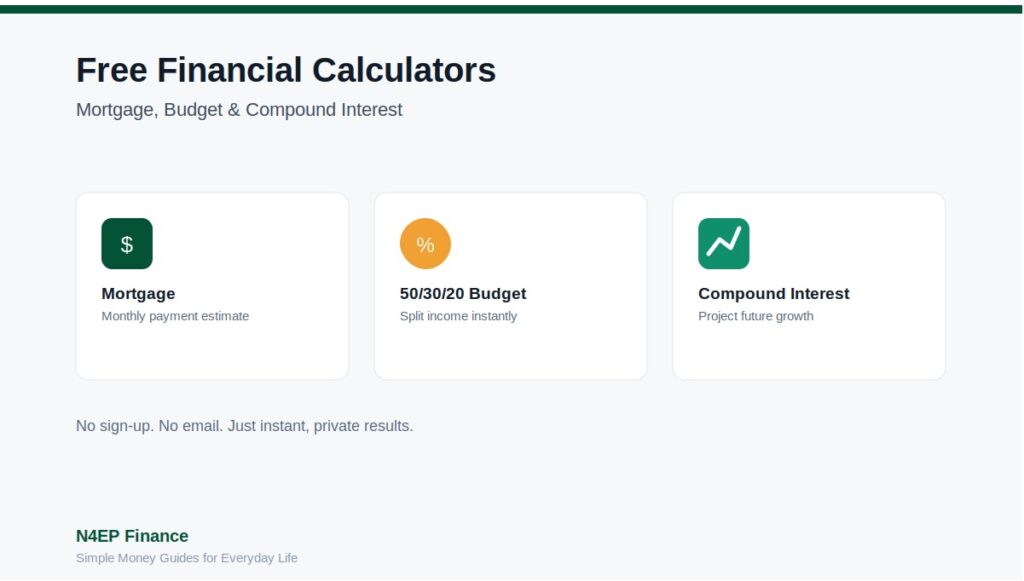
Financial calculators take the guesswork out of everyday money decisions. This page brings together seven free financial calculators in one place — covering mortgages, budgeting, investing, take-home pay, net worth, inflation, and even your money personality — so you can run real numbers instantly, right in your browser.
No sign-up, no email address, and no downloads are required for any of these financial calculators. Whether you’re planning a home purchase, building a monthly budget, checking your paycheck, or tracking your net worth over time, these tools give you a fast, private starting point before you talk to a lender or financial advisor.
Mortgage Payment Calculator
Estimate your monthly mortgage payment based on home price, down payment, interest rate, and loan term. This calculator uses the same amortization formula lenders use to calculate principal and interest, so you can quickly compare how a larger down payment or a shorter loan term changes your monthly cost.
Mortgage Payment Calculator
If you’re just starting to explore homeownership, our First-Time Homebuyer’s Guide walks through the full process from credit score to closing day, and pairs well with the numbers this calculator gives you.
50/30/20 Budget Calculator
One of the simplest financial calculators on this page, this tool shows how your monthly income breaks down across needs, wants, and savings using the popular 50/30/20 budgeting rule. Enter your monthly take-home pay and instantly see suggested spending limits for each category.
50/30/20 Budget Calculator
For a deeper explanation of how this method works and how to adjust it for high cost-of-living areas, read our full guide to the 50/30/20 budget rule.
Compound Interest Calculator
See how your savings or investments could grow over time with consistent contributions and compound growth. This tool factors in your starting amount, monthly contributions, expected annual return, and time horizon to project a future value.
Compound Interest Calculator
New to investing? Our guide on how to start investing with just $100 explains exactly where beginners should put their first dollars to work.
Take-Home Pay (Paycheck) Calculator
This paycheck calculator estimates your net take-home pay after federal tax, an estimated state tax rate, and FICA (Social Security and Medicare). Enter your annual salary, pay frequency, state, and any 401(k) contribution to see a per-paycheck estimate.
This is a simplified estimate for planning purposes only — actual withholding depends on your W-4 elections, filing status, deductions, and exact state/local rates.Take-Home Pay (Paycheck) Calculator
Since credit and cash flow often go hand in hand, our guide on how to improve your credit score fast is a useful next stop once your paycheck numbers are clear.
Net Worth Tracker
Among these financial calculators, the net worth tracker is the only one designed for repeat use over time. Add up your assets — cash, investments, home value — and subtract your debts to see your current net worth. Your numbers are saved privately in your own browser, so you can return and update them every few months to track your progress.
Your numbers are saved privately in your own browser — nothing is sent to our server.Net Worth Tracker
Assets
Debts
If you’re just getting started building assets, our guide on how much to keep in an emergency fund is a good foundation before tackling longer-term net worth goals.
Inflation Calculator
See how the purchasing power of a dollar amount has changed between two years, based on approximate average U.S. inflation rates by decade. This is a fun and genuinely useful tool for understanding why prices — and paychecks — need to keep pace with inflation over time.
Based on approximate average annual U.S. inflation rates by decade. For official historical CPI data, see bls.gov.Inflation Calculator
What’s Your Money Personality?
Not every financial calculator on this page is about numbers — this quick quiz helps you understand your natural relationship with money. Answer five quick questions to find out whether you’re a Saver, an Investor, an Enjoyer, or an Avoider, along with a tip suited to your style.
Answer 5 quick questions to find out. 1. A surprise $500 shows up. You: 2. How often do you check your bank balance? 3. Your ideal financial goal right now is: 4. How do you feel about budgeting? 5. A friend asks for money advice. You'd tell them to:What's Your Money Personality?
How Accurate Are These Financial Calculators?
Each of these financial calculators uses standard, widely accepted formulas — the same amortization, budgeting, tax, and compound growth formulas used across the finance industry. That said, they’re designed for estimates and planning purposes, not exact figures.
Actual mortgage quotes will factor in your specific credit profile, property taxes, and insurance. Actual paycheck withholding depends on your exact W-4 elections and local tax rules. Actual investment returns will vary year to year rather than growing at a smooth, fixed rate.
For official mortgage rate data and additional consumer tools, the Consumer Financial Protection Bureau offers free, unbiased resources that pair well with the estimates on this page.
Which Financial Calculator Should You Use First?
Buying a home soon? Start with the mortgage calculator to understand what different down payments and loan terms mean for your monthly budget.
Trying to get your spending under control? The 50/30/20 calculator gives you an instant snapshot of where your income should be going.
Curious what you’ll actually take home from your next paycheck? The paycheck calculator breaks down federal tax, state tax, and FICA in seconds.
Want to track your financial progress over months and years? The net worth tracker is built specifically for that kind of repeat use.
The Bottom Line
These financial calculators are meant to be a starting point, not a final answer. Try adjusting the numbers in each one a few times to see how sensitive your results are to small changes — moving a mortgage down payment from 10% to 20%, or increasing a monthly investment contribution by even $50, can compound into a meaningful difference over time.
Why Use Free Financial Calculators Instead of Guessing?
Rough mental math around big financial decisions is where a lot of people go wrong — underestimating a mortgage payment, overestimating take-home pay, or losing track of how debt has quietly grown relative to assets. Financial calculators remove that guesswork by applying the same formulas professionals use, instantly and privately, without requiring a consultation just to get a starting number.
Used together, the seven tools on this page cover most of the financial questions people search for help with: what a home will actually cost each month, how to structure a budget, how paychecks translate to real take-home dollars, how savings compound over time, and how net worth changes as habits improve. Revisiting this page periodically — especially the net worth tracker — turns a one-time calculation into an ongoing habit worth building.
Disclaimer: These calculators provide estimates for general informational purposes only and do not constitute personalized financial advice. Actual results may vary based on factors not included in these simplified calculations.